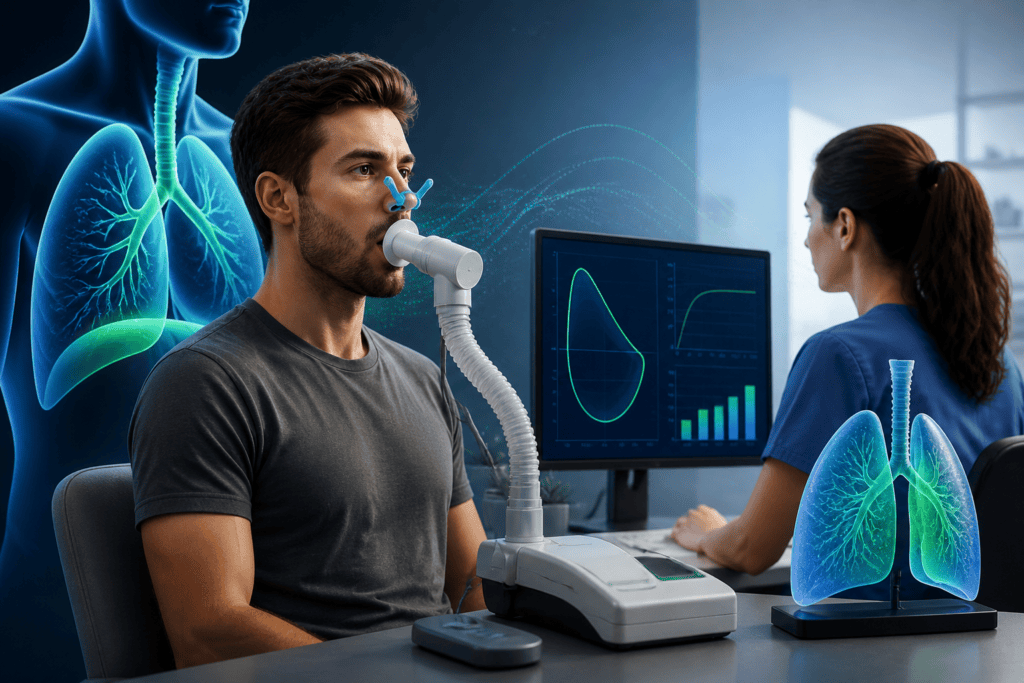
Spirometry is like the trusty Swiss Army knife in the realm of lung diagnostics. This nifty little procedure gives us a peek into how well our lungs are doing by measuring how much air you can inhale and exhale—and how fast you can do it. Here, we’ll dive into what happens during spirometry, interpret what those normal numbers mean, and get a grip on reading lung function results. This guide is for our fellow healthcare folks, coding and billing teams, and anyone else who’s just a wee bit curious about spirometry magic.
If you want more detail, read our article on Gingival Graft (Gum Graft Surgery): Types, Recovery, and Results guide.
Why It Matters
So, what’s the real deal with spirometry? It’s like the ground zero for checking out our respiratory health. Sure, it’s measuring lung capacity, but it’s got a much bigger job. It’s a detective in diagnosing conditions like COPD, asthma, and a bunch of other lung-related issues. Beyond the numbers, how we make sense of these outcomes and use them in treatment plans is super important. It’s this dance of interpretation and application that’s key to getting those diagnoses and treatment plans spot on.
Diving into the Research and Rules
When it comes to pinning down obstructive airway diseases, the American Thoracic Society (ATS) and the European Respiratory Society (ERS) agree that spirometry is the top dog. A spirometer measures your Forced Vital Capacity (FVC) and Forced Expiratory Volume in one second (FEV1)—essential pieces of the puzzle to figure out if there’s any obstruction, restriction, or if your lungs are as normal as a sunny day.
Here’s an interesting tidbit: that FEV1/FVC ratio is the Sherlock Holmes of diagnosing obstructive lung disease. If it dips below 70%, something’s likely obstructed—COPD being a frequent culprit. The guidelines from the Global Initiative for Chronic Obstructive Lung Disease (GOLD) give us the framework for piecing together these results, with accuracy being the name of the game.
When Things Get Tricky
Out in the wild, spirometry can be a bit of a puzzle due to a bunch of factors. Patient effort, keeping the equipment in check, or even the weather might throw a wrench in the works. Plus, everyone’s got different “normal” values—age, sex, height, and ethnic background all play a part—and this makes interpretation a tad more complicated. So, having those reference values and equations tailored for different folks becomes super important.
Healthcare providers really need to get these subtleties. And for our coding and billing pals, knowing the right CPT codes—94010 for basic spirometry and 94060 for the bronchodilator-responsiveness version—is crucial for keeping everything running smoothly in the paperwork department.
How to Apply This in Real Life
Bringing spirometry into everyday practice amps up patient care by catching respiratory issues early and tracking them over time. Making sure everyone involved in the testing is properly trained and the gear is regularly spruced up can make all the difference. Keeping up with the latest guidelines and knowing the reference values that fit your patients is also critical.
And a shoutout to the coders and billers: stick to those accurate coding practices to sidestep reimbursement hiccups. Being clued up on what different payers like Medicare and Medicaid expect can save a ton of headaches and keep your healthcare ship sailing smoothly.
You may also find our guide to Pelvic Pain After Sex: Common Gynecological and Urological Causes guide helpful.
For a closer look, see our guide to Extra Teeth Growing in the Gums (Hyperdontia): Causes and Removal guide.
Main Points to Remember
- Spirometry plays a crucial role in figuring out lung function and spotting respiratory conditions.
- Understanding FVC and FEV1 is central to making sense of spirometry results.
- Patient demographic differences call for tailored population-specific reference values.
- Consistent training and calibration ensure spirometry test accuracy.
- Spot-on coding and billing keep things running for healthcare providers and teams.
Evidence Table
| Question | Evidence / Guidance | Practical Meaning | Source |
|---|---|---|---|
| What does the FEV1/FVC ratio tell us? | A ratio under 70% points to possible obstructive lung disease. | Useful in diagnosing issues like COPD. | GOLD Guidelines |
| How does patient variability shake up results? | Normal values differ with age, sex, height, and ethnicity. | Calls for precise reference values for spot-on interpretation. | ATS/ERS Standards |
| What CPT codes are common in spirometry? | Codes like 94010 and 94060 are used depending on the test. | Ensures proper billing and reimbursement go as planned. | AMA CPT Resources |
Disclaimer: This content is published strictly for educational and general informational purposes. It does not constitute professional medical, legal, financial, or technical advice. Always consult a certified specialist or licensed professional regarding your specific situation before making decisions.