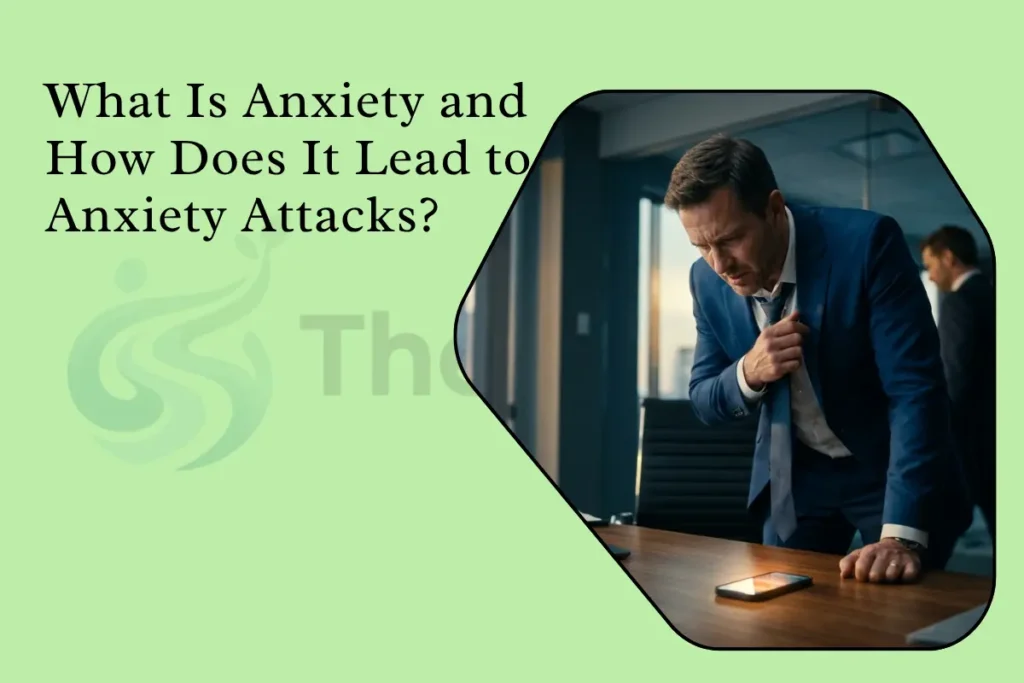
Grasping the mechanics of the human stress response is more than a clinical exercise; it is a prerequisite for sustained professional excellence. While often dismissed as a simple emotional shift, anxiety is actually a complex biological defense mechanism. When this system becomes dysregulated, it can trigger an anxiety attack, essentially a physiological “system crash” capable of compromising the performance of even the most experienced executives.
Defining the Core: What Is Anxiety?
At its foundation, anxiety is a future-oriented mood state. It is the body’s way of preparing for a perceived threat that has not yet occurred. Unlike fear, which is a response to an immediate danger, anxiety is characterized by apprehension regarding potential upcoming challenges American Psychological Association: Anxiety.
- Amygdala monitors incoming sensory data.
- Prefrontal cortex analyzes potential risks.
- Nervous system enters heightened readiness.
- Cortisol levels begin rising steadily.
- Heart rate increases slightly but noticeably.
- Focus narrows to identify specific threats.
- Muscle tension prepares for physical action.
As Dr. David H. Barlow notes in his book Anxiety and Its Disorders: The Nature and Treatment of Anxiety and Panic, “Anxiety is a unique and coherent cognitive-affective structure within our defensive and motivational systems.” This highlights that the condition is an integrated part of our survival toolkit, not just a random occurrence [Barlow, D. H. (2002). Anxiety and its disorders].
The Escalation: How It Leads to Anxiety Attacks
The transition from a state of general worry to an acute anxiety attack is usually a matter of threshold. When the brain’s “alarm system” fails to receive a “stand down” signal from the rational mind, it triggers an all-out emergency response. This is the point where internal tension becomes an externalized crisis Harvard Health: Understanding the Stress Response.
- Rational checks fail to stop worry.
- Feedback loops amplify minor physical signs.
- Adrenaline floods the entire bloodstream.
- Breathing becomes shallow and very rapid.
- The brain perceives a total emergency.
- Physical symptoms peak within ten minutes.
- System exhaustion follows the event.
You don’t just wake up and have an attack without a physiological runway. It is a cumulative process. Small stressors stack until the structural integrity of your emotional regulation collapses. I have seen professionals ignore these stacks for years until their body finally forces a shutdown.
The Professional Differentiator: Anxiety vs. Panic
While the terms are used interchangeably in casual talk, understanding the difference between anxiety and panic attack matters for treatment. Anxiety attacks usually build up over time due to prolonged stress, unlike a sudden panic attack. Panic attacks, however, are often sudden and unprovoked Mayo Clinic: Panic Attacks and Panic Disorder.
| Feature | Anxiety Attack | Panic Attack |
| Onset | Gradual build-up of tension | Sudden and often unexpected |
| Duration | Can persist for long periods | Peaks quickly, ends soon |
| Primary Driver | Specific stressors or worries | Internal physiological “misfire” |
| Clinical Status | Not a specific DSM-5 diagnosis | Recognized clinical condition |
| Intensity | Moderate to severe | Extreme and overwhelming |
| Physical Feeling | Heaviness, restlessness, “on edge” | Heart racing, fear of dying |
The Role of Cognitive Misinterpretation
A primary driver for the escalation into an attack is how we interpret our own body. If you feel your heart skip a beat and think, “I am having a heart attack,” your brain will respond by dumping more adrenaline to help you survive. This creates a self-fulfilling prophecy of terror.
In the words of Dr. Aaron T. Beck, the father of Cognitive Therapy, in Cognitive Therapy of Anxiety Disorders: “The patient’s tendency to catastrophize a bodily sensation leads directly to the mounting spiral of anxiety” [Beck, A. T., & Clark, D. A. (2010). Cognitive Therapy of Anxiety Disorders].
- Initial sensation triggers slight concern.
- Mind assigns a deadly meaning.
- Body reacts to that scary thought.
- Physical symptoms get much worse.
- Logic becomes completely unavailable.
- Fear of fear drives escalation.
- Control feels totally lost.
Environmental and Biological Triggers
We cannot look at this through a single lens. Biology plays a role, but the environment is the match that lights the fuse. High-pressure work environments, lack of sleep, and poor nutritional habits act as “kindling” for an anxiety attack.
- Genetic predisposition increases baseline risk NIMH: Anxiety Disorders.
- Chronic sleep deprivation lowers thresholds.
- Excessive caffeine intake mimics anxiety.
- High-stakes deadlines create constant pressure.
- Social isolation reduces emotional buffers.
- Past trauma remains stored neurally.
- Poor gut health affects neurotransmitters Cleveland Clinic: Gut-Brain Connection.
“Anxiety’s purpose is to keep us alive, but in the modern world, it often reacts to emails like they are predators,” says Dr. Robert Leahy in The Worry Cure. This is the “evolutionary mismatch” we deal with daily.
Management Strategies for the “Boots-on-the-Ground” Professional
If you’re in the middle of a high-pressure meeting and feel the symptoms rising, you need immediate, physiological interventions to signal the brain that the threat is not real National Health Service: 5-4-3-2-1 Grounding Technique.
- Lengthen the exhale during breathing (Parasympathetic activation).
- Label the feeling as “just adrenaline” (Cognitive distancing).
- Splash cold water on your face (Vagus nerve stimulation).
- Engage large muscle groups (Releasing physical energy).
- Focus on five visible objects (Grounding).
- Avoid fighting the physical feeling.
- Accept the discomfort until it fades.
Most people try to fight an attack, which only tells the brain the danger is real. Instead, you have to lean into it. By acknowledging the adrenaline without reacting to it, you starve the fire of its oxygen.
The Bottom Line
Anxiety is a manageable biological state. It leads to anxiety attacks when the internal communication between the emotional brain and the logical brain breaks down. By understanding the triggers and the physiological “runway,” professionals can intercept the process before it reaches a peak. Do not wait for a total system failure to address your baseline stress.
Further Research
- World Health Organization: Global Statistics on Anxiety Disorders https://www.who.int/news-room/fact-sheets/detail/anxiety-disorders Key Source for: Global prevalence, ICD-11 definitions, and public health impact.
- Harvard Health: Understanding the Stress Response https://www.health.harvard.edu/staying-healthy/understanding-the-stress-response Key Source for: The biological “cascade” of adrenaline/cortisol and the fight-or-flight mechanism.
- Mayo Clinic: Anxiety vs. Panic Attack Criteria https://www.mayoclinic.org/diseases-conditions/anxiety/symptoms-causes/syc-20350961 Key Source for: Differentiating clinical symptoms and diagnostic markers of panic vs. general anxiety.
- NIMH: Comprehensive Guide to Anxiety Science https://www.nimh.nih.gov/health/topics/anxiety-disorders Key Source for: In-depth research on genetic risk factors and current clinical treatment protocols.
- Anxiety & Depression Association of America (ADAA): Resources for Professionals https://adaa.org/workplace-anxiety Key Source for: Management strategies specifically tailored for high-pressure professional environments.

