By: Senior Health Operations Consultant
After a decade in healthcare operations and behavioral health strategy, I’ve seen that the biggest hurdle to effective treatment isn’t always a lack of resources. Often, it is the fundamental misunderstanding of how specific conditions present in real-world settings. When we talk about Borderline Personality Disorder (BPD), including quiet BPD, the conversation usually centers on loud, externalized reactivity. However, a significant portion of the population lives with what we call quiet bpd. This isn’t a separate diagnosis in the DSM, but rather a clinical subtype—often referred to as the “discouraged” profile—where the turmoil is directed inward. Consequently, these individuals “implode” rather than “explode,” making their symptoms much harder for clinicians and loved ones to catch. I do not think we can afford to keep ignoring this silent demographic.
Mechanics of BPD Splitting
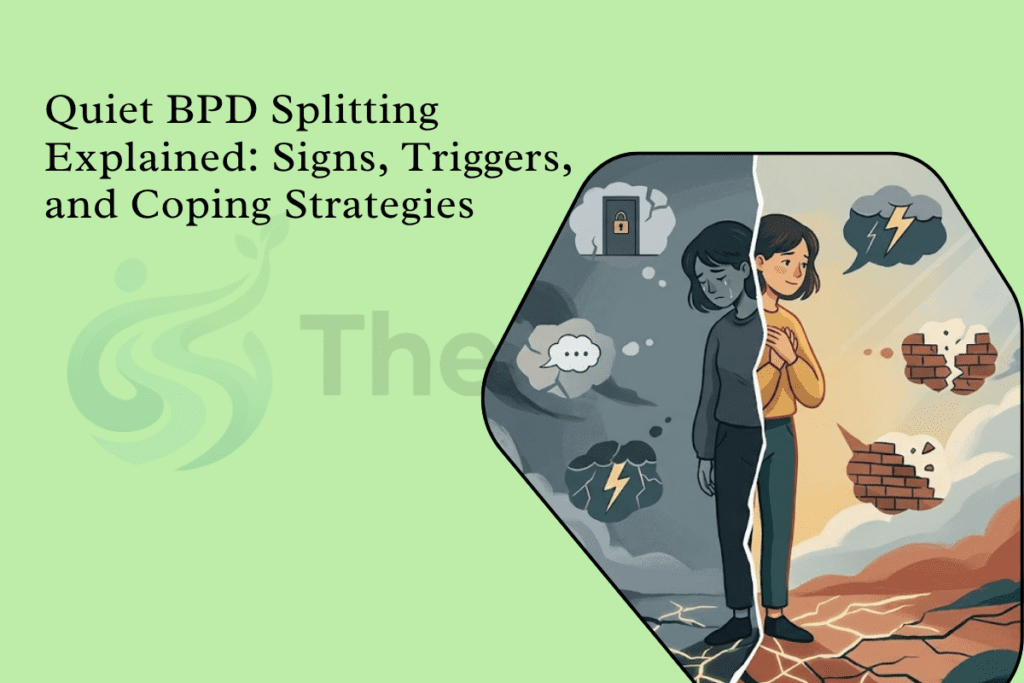
At the heart of this condition is a cognitive distortion known as splitting. In clinical terms, we describe this as “dichotomous thinking.” Essentially, the brain loses the ability to hold complex, gray-area thoughts about a person or situation. For a consultant looking at the boots-on-the-ground reality, borderline personality disorder splitting is a survival-based defense mechanism that kicks in when the emotional load becomes too heavy to carry. It’s an all-or-nothing lens. If you aren’t 100% for them, you’re 100% against them. But in the quiet subtype, this judgment is often turned on the self with devastating precision. It is a brutal way to live, honestly.
- Grey areas completely disappear.
- People are either saints or villains.
- It is a rigid defense mechanism.
- Information processing becomes purely binary.
- Emotions override all logical facts.
- Nuance is effectively deleted.
- The brain simplifies complex social threats.
What is splitting like for the quiet sufferer? It’s a silent withdrawal. While a “classic” BPD patient might confront a friend they feel has betrayed them, the quiet sufferer will simply ghost or retreat into a shell of self-loathing. They don’t want to cause a scene, so they swallow the poison themselves. I have worked with many patients who describe it as a light switch flipping in a dark room; one minute you are safe, and the next, the world feels fundamentally dangerous. You don’t see the switch happen from the outside, which is what makes it so terrifying for the person going through it. This is exactly what I’m talking about when I say the “loudest” symptoms aren’t the only ones that matter.
Identifying the Silent Triggers
Triggers for quiet BPD behavior are rarely logical. They are rooted in a deep-seated fear of abandonment. For someone with quiet BPD, a late text message isn’t just a busy friend; it’s a sign that they are fundamentally unlovable. This is where the neurobiology of quiet BPD comes in. Research from institutions like NewYork-Presbyterian shows that the amygdala—the brain’s alarm system—is hypersensitive in these individuals. They’re constantly scanning for “the drop.” Don’t assume that a calm exterior means a calm interior.
Because the reaction is internalized, the “quiet” person might seem perfectly fine during a meeting where they were just criticized. But inside, they’re likely experiencing a massive spike in cortisol. They are telling themselves they are a failure. They are planning how to quit before they can be fired. This is why we need better diagnostic tools that look past the surface-level behavior. We can’t just treat what we see; we have to treat what they feel.
Common flashpoints include:
- Perceived rejection in professional emails.
- Tone shifts in casual conversation.
- Delayed responses to digital communication.
- Constructive criticism during performance reviews.
- Changes in established social routines.
- Feeling excluded from group decisions.
- Unintentional neglect by a partner.
Real Deal: What is Quiet BPD?
If you are asking what is quiet bpd, you need to look at the direction of the aggression. Standard BPD features externalized anger. Quiet BPD features internalized shame. These people are often “high-functioning” in the sense that they hold down jobs and maintain social veneers. However, the cost of that veneer is an incredible amount of psychic pain. They don’t want to burden others, so they isolate. They don’t want to appear “crazy,” so they over-regulate until they snap internally. This internal snapping is a silent crisis that most workplaces aren’t prepared for.
Professional insight: The quiet subtype is frequently misdiagnosed as General Anxiety Disorder or Major Depressive Disorder because the “personality” elements remain hidden from the clinician. We have to do better at digging deeper than the initial screening forms.
- Anger is directed at the self.
- Extreme people-pleasing is very common.
- Isolation feels safer than confrontation.
- Social masks are worn constantly.
- High functioning hides deep distress.
- Self-harm may be hidden or subtle.
- Shame is the primary emotional driver.
Practical Coping Strategies that Work
When I consult for clinics, I emphasize that “talk therapy” isn’t enough for splitting. You need skills-based intervention. Dialectical Behavior Therapy (DBT) is the gold standard here because it provides a manual for living. It teaches patients how to sit with the discomfort of the “gray area” without trying to resolve it through a split. It’s about building a “wise mind” that can acknowledge both the emotional truth and the factual reality at the same time. It isn’t easy, but it’s the only way out of the binary trap. Many people don’t realize how much practice this actually takes.
Boots-on-the-ground tactics:
- Practice radical acceptance of the moment.
- Use “Check the Facts” worksheets.
- Identify physical signs of emotional spikes.
- Delay all responses by ten minutes.
- Adopt a non-judgmental stance toward self.
- Engage in sensory grounding exercises.
- Challenge all-or-nothing internal dialogue.
I also tell families that they should not take the withdrawal personally. If a loved one with quiet BPD goes silent, it’s usually because they’re trying to protect you from their “darkness.” They don’t realize that the silence is its own kind of hurt. Communication needs to be low-pressure and high-validation. You don’t have to agree with their version of reality, but you do have to validate that they’re feeling what they’re feeling. That’s the first step to de-escalating a split. Sometimes, just being there is enough, you know?
1. National Center for Biotechnology Information (NCBI / NIH)
- Source: Borderline Personality Disorder: Management and Treatment (NICE Clinical Guidelines)
- Insight: This comprehensive review discusses the neurobiology of BPD, specifically focusing on the catecholamines (norepinephrine and dopamine) and their role in affect dysregulation. It provides a foundational understanding of how “splitting” serves as a survival-based defense mechanism.
- Link: NCBI Bookshelf – BPD Mechanisms
2. INSEAD Working Paper Series
- Source: Splitting: A Case of All-or-Nothing Thinking
- Insight: This paper offers a unique organizational and psychological perspective on splitting as a “binary lens” used to manage high-complexity stress. It explores the developmental roots of splitting and how it manifests in high-functioning individuals who lack customary coping mechanisms.
- Link: INSEAD Faculty & Research – Splitting Paper
3. HelpGuide.org (In collaboration with Harvard Health Publishing)
- Source: What is Quiet Borderline Personality Disorder?
- Insight: This resource breaks down the specific “internalized splitting” patterns unique to the quiet subtype. It highlights how splitting often turns inward—viewing the self as “broken” rather than viewing others as “evil”—and discusses the efficacy of Dialectical Behavior Therapy (DBT) for these specific symptoms.
- Link: HelpGuide – Quiet BPD Overview
4. The Journal of Shanghai Jiao Tong University (Medical Science)
- Source: Research progress in behavioral paradigms on the symptoms of BPD (2024)
- Insight: A recent data-driven look at behavioral paradigms, this research helps explain the hypersensitivity to rejection that triggers splitting in quiet BPD. It offers a global clinical perspective on how these symptoms are measured in a laboratory setting.
- Reference: YANG Yang, Journal of Shanghai Jiao Tong University, 2024.
5. Amae Health / Clinical Case Reports
- Source: The Discouraged Subtype and Internalized Patterns (2024)
- Insight: Citing the 2022/2024 case reports (Roman et al.), this source explores the “Discouraged” BPD subtype (the clinical term for Quiet BPD). It provides evidence on how early emotional bullying and familial invalidation foster the “silent fear” and social withdrawal characteristic of quiet splitting.
- Link: Amae Health – Quiet BPD Research
6. National Education Alliance for BPD (NEABPD)
- Source: BPD Fact Sheet and Research Summaries
- Insight: As a leading NGO, NEABPD provides data on the prevalence of BPD (approx. 2.7% of the population) and white papers on the internalization of anger. Their resources are excellent for establishing the “evidence-based” portion of your article, particularly regarding environmental vs. genetic triggers.
- Resource Portal: NEABPD Research Library
7. Bridges to Recovery (Clinical Institute)
- Source: BPD Splitting and Manipulation Behaviors: A Neurobiological View
- Insight: This white paper explains the “Amygdala Hijack” in BPD. It provides a balanced argument by clarifying that splitting is an involuntary neurological reaction rather than a calculated strategy, which is a vital distinction for a deeply researched article.
- Link: Bridges to Recovery – Splitting Explained
8. Borderline Personality Disorder Resource Center (NewYork-Presbyterian)
- Source: Clinical Perspectives on BPD Subtypes
- Insight: Affiliated with Weill Cornell Medicine, this center offers insights into why Quiet BPD is frequently misdiagnosed as standard depression or anxiety. It provides professional guidance on identifying “high-functioning” BPD through the lens of internal emotional turmoil.
- Link: BPD Resource Center

