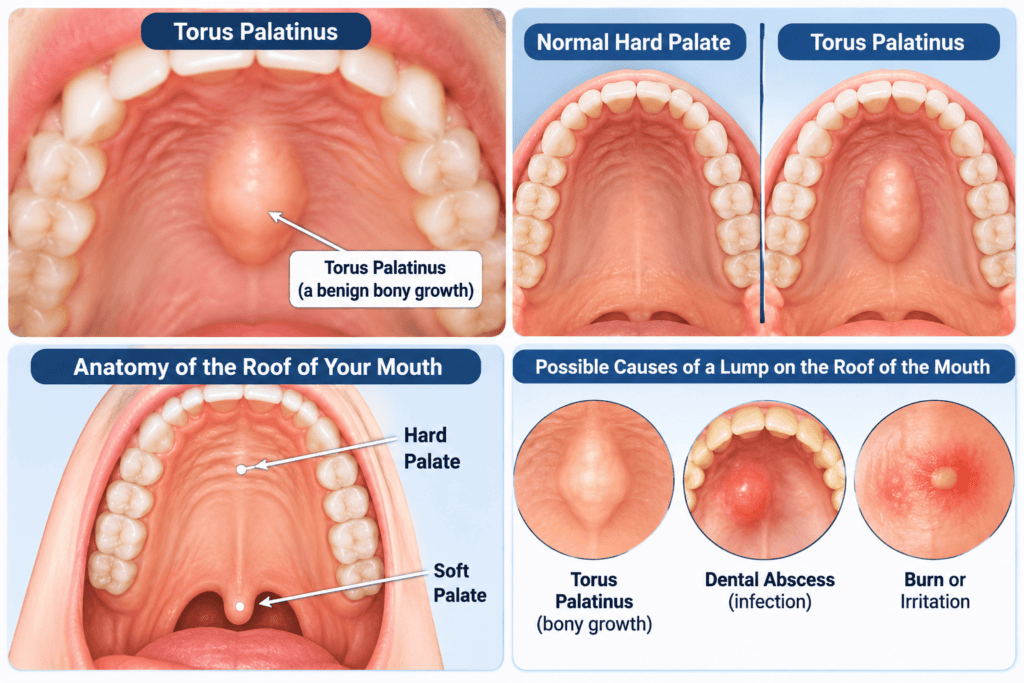
Finding a hard knot or lump on the roof of your mouth can be surprising, especially if you have never noticed it before. You might feel a small bump with your tongue, discover a painful swelling while eating, or notice an unusual change in the shape or texture of your palate.
One common explanation is torus palatinus, a harmless bony growth that develops along the middle of the hard palate. However, not every lump on the roof of the mouth is a torus. Dental infections, irritation, burns, cyst-like lesions, and other oral conditions can also cause bumps or swelling.
The location, texture, appearance, pain level, and duration of the lump can help a dentist determine what may be causing it. A new or persistent lump should not automatically be assumed to be harmless.
This guide explains what a lump on the roof of your mouth might mean, how torus palatinus differs from other causes, what you can do for discomfort, and when to seek professional care.
Quick Answer: What Causes a Lump on the Roof of the Mouth?
A lump on the roof of your mouth can develop for several reasons, including:
- Torus palatinus: A benign bony growth that usually forms in the middle of the hard palate.
- Dental abscess: An infection around a tooth root that can sometimes produce swelling on the palate.
- Mouth injury or burn: Irritation from hot food, sharp foods, or accidental trauma.
- Cyst or other soft-tissue growth: A fluid-filled or tissue-based lump that needs professional assessment.
- Inflammation or infection: Certain oral conditions can cause painful swelling, sores, or bumps.
- Other oral lesions: Less commonly, a persistent lump or thickened area can be associated with a potentially serious condition.
A hard, smooth, painless bump in the center of the hard palate that has grown slowly may be consistent with torus palatinus. A painful, rapidly changing, bleeding, or persistent lump needs examination by a dentist or healthcare professional.
What Is the Roof of Your Mouth?
The roof of your mouth is called the palate. It has two main sections:
- Hard palate: The firm, bony front portion of the roof of your mouth.
- Soft palate: The softer, flexible area toward the back of your mouth.
The hard palate contains bone covered by a layer of oral tissue. This is where torus palatinus typically develops. The soft palate contains muscles and other soft tissues, so a bump in this area may have different possible causes.
Knowing whether a lump is on the hard or soft palate can help your dentist narrow down the possibilities.
Torus Palatinus: A Common Cause of a Hard Lump on the Roof of the Mouth
Torus palatinus is a benign bony growth that develops on the hard palate, usually along the center line of the roof of the mouth.
It may look like a small raised bump, a broad ridge, or several connected bony elevations. Some are barely noticeable, while others are large enough to affect how a person eats or wears dental appliances.
Most torus palatinus growths are harmless and do not require treatment.
What Does Torus Palatinus Look and Feel Like?
A torus palatinus commonly has these characteristics:
- A hard, bone-like texture.
- A smooth or slightly uneven surface.
- A position near the middle of the hard palate.
- Slow growth over time.
- Little or no pain under normal circumstances.
- Normal-looking tissue covering the growth, although the surface may sometimes become irritated.
You may first notice it when your tongue touches the roof of your mouth. Some people discover it during a routine dental examination.
A torus can be a single rounded bump or a group of smaller bony elevations. Its size and shape vary from person to person.
What Causes Torus Palatinus?
The exact cause of torus palatinus is not fully understood. Research suggests that several factors may contribute to its development.
1. Genetics
Some people may have a family tendency to develop oral bony growths. Having a close relative with a similar bump may increase the likelihood, although family history does not confirm a diagnosis.
2. Jaw structure and anatomy
Differences in the shape of the palate, jaw, and dental arch may contribute to the development of oral tori.
3. Teeth grinding and clenching
Repeated pressure from clenching or grinding may be associated with the development of bony growths in some people. However, this does not establish teeth grinding as the sole cause.
4. Age
Torus palatinus is often noticed in adulthood. It may develop gradually, and some people do not recognize it until later in life.
5. Other possible contributing factors
Researchers have investigated bone density, chewing habits, and local mechanical stress. The evidence does not establish one specific cause for everyone.
The important point is that torus palatinus is not generally caused by an infection, poor oral hygiene, or cancer.
Can Torus Palatinus Be Painful?
Usually, torus palatinus is painless. However, it can become uncomfortable if the tissue covering the bone gets scratched, irritated, or injured.
For example, hard chips, crusty bread, or other sharp foods may rub against the raised area and cause soreness. A large growth may also make eating, speaking, or wearing dentures more difficult.
If a previously painless torus suddenly becomes painful, do not assume that the bone growth itself is responsible. A dentist should check for an ulcer, injury, infection, or another condition.
Does Torus Palatinus Go Away on Its Own?
No. Torus palatinus is a bony growth, not a temporary fluid-filled bump. It generally does not disappear without surgical removal.
However, most people do not need to have it removed. A dentist may simply monitor it during routine dental visits.
Is Torus Palatinus Dangerous?
Torus palatinus is generally a harmless, noncancerous growth. It does not usually cause health problems.
However, it can occasionally create practical difficulties, including:
- Food becoming trapped around the growth.
- Repeated irritation or injury to the covering tissue.
- Difficulty fitting dentures or other dental appliances.
- Discomfort while chewing.
- Problems with speech or swallowing when the growth is particularly large.
A dentist can determine whether the bump is consistent with torus palatinus and whether treatment is necessary.
Other Causes of a Lump or Bump on the Roof of the Mouth
Torus palatinus is one possible explanation, but several other conditions can produce a lump, swelling, or painful bump on the palate.
1. Dental Abscess
A dental abscess is a collection of pus caused by a bacterial infection. In some cases, an infection around the root of an upper tooth can spread toward the palate and produce a swollen, painful lump.
A dental abscess may cause:
- A painful or tender bump on the roof of the mouth.
- Toothache or pain near an upper tooth.
- Sensitivity to hot or cold food and drinks.
- A bad taste in the mouth.
- Redness or swelling.
- Fever or swollen lymph nodes in some cases.
A dental abscess needs prompt dental treatment. It will not reliably disappear on its own, even if the pain temporarily improves.
Seek urgent dental care if you suspect an abscess. If swelling is severe or you have difficulty breathing, speaking, or swallowing, seek emergency medical care.
2. Mouth Burn From Hot Food or Drinks
A burn can create a painful, raised, or blister-like area on the roof of your mouth.
This may happen after eating very hot pizza, drinking hot coffee, or consuming food that has just come out of an oven.
Possible symptoms include:
- A painful area on the palate.
- Redness or tenderness.
- A blister or peeling surface.
- Pain when eating or drinking.
- Sensitivity to spicy, acidic, or hot foods.
A minor burn usually improves as the tissue heals. Cool water, soft foods, and avoiding irritating foods can help reduce discomfort.
If the injury is severe, symptoms worsen, or swallowing becomes difficult, seek medical attention.
3. Mouth Injury or Physical Irritation
The roof of your mouth can become irritated by sharp, crunchy, or hard foods. Accidental injuries may also occur while eating or during dental procedures.
An irritated area may feel raised or swollen and can be tender when touched.
Possible triggers include:
- Sharp food edges.
- Accidental scratches.
- Dental appliances that rub against the palate.
- Repeated friction.
- Other minor oral injuries.
Avoid further irritation and keep the area clean. If the lump does not improve or becomes increasingly painful, arrange a dental examination.
4. Oral Cyst or Soft-Tissue Growth
Some oral lumps are caused by cysts or other growths in the soft tissue.
A cyst may feel different from torus palatinus. It can be softer, rounded, or slightly movable depending on its location and type.
Not every cyst develops on the roof of the mouth, and a bump’s appearance alone cannot establish what it is.
A dentist may examine the area and decide whether further testing or referral to an oral surgeon is needed. Do not try to drain, squeeze, or cut a lump yourself.
5. Mouth Ulcer or Inflammatory Lesion
A mouth ulcer is usually an open sore rather than a true bony lump. However, swelling around an ulcer can make the area feel raised or uneven.
An ulcer may cause:
- Localized pain or burning.
- A white or yellowish center.
- A red border.
- Discomfort while eating.
- Sensitivity when the tongue touches the area.
Some ulcers develop after minor injury, while others are associated with infections or inflammatory conditions.
A sore that does not heal within the expected period should be examined, particularly if it lasts more than two weeks or is accompanied by other changes.
6. Viral or Other Oral Infections
Certain infections can produce blisters, sores, or irritated areas inside the mouth. These may sometimes be noticed on the palate.
The appearance varies depending on the cause. Some infections produce multiple small sores rather than one hard lump.
Other symptoms may include fever, sore throat, swollen glands, or discomfort when swallowing.
A healthcare professional can help determine whether an infection is responsible and whether treatment is needed.
7. Other Oral Lesions, Including Potentially Serious Growths
Not every oral lump is benign. A persistent or unexplained growth can occasionally be associated with an abnormal tissue change or oral cancer.
Warning signs may include:
- A lump that does not go away.
- A sore that does not heal.
- A red or white patch.
- Unexplained bleeding.
- Persistent pain or numbness.
- Difficulty chewing, swallowing, or speaking.
- A lump in the neck.
These symptoms do not automatically mean cancer. Many have noncancerous explanations. However, persistent changes need professional evaluation rather than repeated self-treatment.
How to Tell the Difference Between Torus Palatinus and Other Bumps
The location and texture of a lump can offer clues, but they cannot replace a dental examination.
| Feature | Torus palatinus | Other possible causes |
|---|---|---|
| Texture | Usually very hard, like bone | May be soft, firm, fluid-filled, or swollen |
| Location | Usually centered on the hard palate | Can occur in different parts of the palate |
| Pain | Usually painless | May be painful or tender |
| Growth | Usually develops slowly | May appear suddenly or change quickly |
| Surface | Often smooth | May be red, ulcerated, blistered, or irregular |
| Common examples | Benign bony growth | Abscess, injury, burn, cyst, or other lesion |
| Treatment | Often no treatment needed | Depends on the underlying cause |
Important: These are general patterns, not diagnostic rules. A hard lump is not automatically a torus, and a painless lump is not automatically harmless.
Why Is There a Painful Bump on the Roof of My Mouth?
A painful bump on the roof of your mouth can have several explanations. Unlike a typical torus palatinus, which is usually painless, a painful bump may be related to inflammation, infection, or tissue injury.
Possible causes include:
- A dental abscess near an upper tooth.
- A burn from hot food or drinks.
- An ulcer or irritated area.
- An injury from sharp food.
- An infected or inflamed oral lesion.
- Irritation around an existing bony growth.
If you have a pain bump on roof of mouth, pay attention to whether the pain is getting worse, whether there is toothache, and whether you have fever, swelling, or difficulty swallowing.
A small painful lump in roof of mouth should be checked if it is worsening, has no clear explanation, or does not improve. A dentist can assess whether the problem is dental, related to the oral tissue, or something else.
Do not press, puncture, or attempt to remove the bump.
What Does a Small Lump on the Top of Your Mouth Mean?
A small lump on top of mouth can be caused by a harmless bony growth, minor injury, inflammation, or another oral condition.
Some people notice a small lump top of mouth only when they run their tongue over the palate. Others see a raised area while brushing their teeth or looking in a mirror.
A small lump may be less concerning when it is stable, painless, and has been present for a long time. However, size alone does not tell you whether a growth is harmless.
If you have a small lump in the roof of your mouth that is new, changing, painful, or persistent, arrange an examination.
What Does an Abnormal Roof of Mouth Look Like?
The roof of the mouth naturally has ridges and variations in shape. The front portion of the hard palate may have small folds called palatal rugae. These normal structures can sometimes feel like bumps.
An abnormal roof of mouth may have changes such as:
- A new lump or raised area.
- Unusual swelling.
- A persistent sore or ulcer.
- A red or white patch.
- A rough or thickened area.
- Bleeding without an obvious injury.
- A change in the shape or texture of the palate.
Not every unusual-looking area is a disease. However, a new or persistent change should be assessed by a dentist.
When Should You Worry About a Hard Lump on the Roof of Your Mouth?
A hard lump on the roof of your mouth deserves attention if it is new, growing, painful, or changing in appearance.
A stable, painless, central bony bump may be consistent with torus palatinus. However, an unexplained hard lump should still be checked, particularly if you have never had it examined.
Arrange a dental or medical appointment if:
- The lump is new and has no obvious explanation.
- It is getting larger.
- It becomes painful or tender.
- It develops an ulcer or changes color.
- It bleeds.
- You notice numbness or persistent discomfort.
- You have difficulty eating, chewing, or swallowing.
- A sore or lump remains for more than two weeks.
The National Institute of Dental and Craniofacial Research recommends professional assessment for persistent oral symptoms, including a lump, sore, or thickened area.
Seek emergency care if you experience difficulty breathing or swallowing, rapidly increasing swelling, or signs of a spreading infection.
How Is a Lump on the Roof of the Mouth Diagnosed?
A dentist or oral healthcare professional usually begins with a physical examination.
1. Reviewing Your Symptoms
Your dentist may ask:
- When did you first notice the lump?
- Has it changed in size?
- Does it hurt when touched?
- Is it hard, soft, or fluid-like?
- Have you recently burned or injured your mouth?
- Do you have tooth pain or signs of infection?
- Have you noticed bleeding, ulcers, or changes in color?
These details help narrow down possible causes.
2. Examining the Palate
The dentist will inspect the roof of your mouth and may gently feel the lump to assess its location, texture, and size.
They may also examine nearby teeth, gums, and other areas of the mouth.
3. Dental Imaging
If the dentist suspects a bony growth or a problem involving an upper tooth, dental X-rays or other imaging may be appropriate.
Imaging is not necessary for every lump. The choice depends on what the examination suggests.
4. Additional Tests or Referral
If a lump looks unusual or cannot be confidently identified, your dentist may refer you to an oral surgeon or another specialist.
A biopsy may be recommended for certain unexplained or suspicious lesions. This involves taking a small tissue sample for laboratory examination.
How Is a Lump on the Roof of the Mouth Treated?
Treatment depends on the cause. A harmless bony growth may need no treatment, while an infection or persistent lesion may require professional care.
Treatment for Torus Palatinus
Most people with torus palatinus do not need treatment.
If the growth interferes with daily activities, an oral surgeon may discuss surgical removal.
Removal may be considered when the growth:
- Interferes with dentures or other dental appliances.
- Makes chewing or swallowing difficult.
- Causes repeated injury to the overlying tissue.
- Creates significant discomfort.
- Interferes with speech or oral function.
Surgery is not usually necessary simply because the bump is present.
Treatment for a Dental Abscess
A dental abscess requires treatment by a dentist. Depending on the source of infection, treatment may involve draining the abscess, root canal treatment, or removing the affected tooth.
Antibiotics may be prescribed in selected situations, but they do not replace treatment of the underlying dental problem.
Treatment for Burns or Minor Injuries
Minor palate burns and injuries often improve with time and gentle care.
A dentist or healthcare professional may recommend appropriate pain relief or other treatment depending on the severity of the injury.
Avoid repeatedly touching or scraping the affected area.
Treatment for Cysts or Other Growths
The treatment of a cyst or other soft-tissue growth depends on its type, size, and location.
Some lesions can be monitored, while others may need further investigation or removal by a qualified professional.
Never attempt to drain or remove an oral lump at home.
What Can You Do at Home for a Painful Bump?
Home care may help relieve discomfort from a minor burn or irritation, but it cannot identify the cause of an unexplained lump.
Consider these steps while arranging appropriate care:
1. Choose soft foods
Eat foods that are easy to chew and less likely to scratch the palate. Avoid sharp chips, crusty bread, and hard snacks if they cause pain.
2. Avoid very hot or irritating foods
Let hot drinks and meals cool before consuming them. Spicy or acidic foods may worsen discomfort in an irritated area.
3. Keep your mouth clean
Brush gently with a soft toothbrush and maintain your usual oral hygiene routine. Avoid aggressively brushing the affected area.
4. Try a gentle saltwater rinse
A mild warm saltwater rinse may help keep an irritated area clean. Do not use water that is too hot, and do not treat a suspected abscess with rinses instead of dental care.
5. Avoid touching the lump
Repeatedly pressing or rubbing a bump can irritate the tissue and make symptoms worse.
6. Seek professional advice if it persists
If the lump does not improve, grows, bleeds, or develops other symptoms, arrange a dental examination.
Do not apply aspirin, alcohol, household chemicals, or unprescribed substances directly to the lump.
Can You Prevent Torus Palatinus?
There is no established way to prevent torus palatinus because its exact cause is not fully understood.
However, maintaining good oral health can help reduce the risk of other problems that may cause bumps or swelling.
Helpful habits include:
- Brush twice daily with fluoride toothpaste.
- Clean between your teeth every day.
- Attend regular dental checkups.
- Avoid chewing foods that repeatedly injure your palate.
- Address teeth grinding or clenching with professional guidance.
- Avoid tobacco products.
- Seek care for dental pain or suspected infection.
These steps do not guarantee that a bony growth will not develop, but they support overall oral health.
Frequently Asked Questions
1. Is a hard lump on the roof of the mouth usually torus palatinus?
A hard, smooth, painless lump located along the center of the hard palate may be torus palatinus. It is a benign bony growth. However, other conditions can also cause hard or firm lumps, so a dentist should confirm the diagnosis.
2. What does it mean if I have a lump in the roof of my mouth?
A lump in roof of my mouth may be caused by torus palatinus, a dental abscess, an injury, a burn, a cyst, or another oral lesion. Its location, texture, duration, and symptoms help guide diagnosis. A new or persistent lump should be examined.
3. Why do I have a hard lump on the hard palate of my mouth?
A hard lump on hard palate of mouth may be a bony growth such as torus palatinus, especially if it is centered, smooth, painless, and has developed gradually. However, a dentist needs to examine it to rule out other causes.
4. Can torus palatinus cause pain?
Torus palatinus is usually painless. It can become uncomfortable if the tissue covering the bone is injured by sharp foods or repeated friction. New or worsening pain should be assessed because another condition may be responsible.
5. Can torus palatinus become cancerous?
Torus palatinus is a benign bony growth and is not considered a precancerous lesion. However, a different lump can occur in the same area. If a bump changes, bleeds, develops an ulcer, or persists without a clear diagnosis, have it examined.
6. Is a small lump on the roof of the mouth normal?
Some people have normal palatal ridges or a benign bony growth. However, a new small lump should not automatically be considered normal. If it is painful, growing, changing, or persistent, ask a dentist to examine it.
7. What causes knots in the mouth?
The phrase knots in mouth can describe different types of lumps or raised areas. They may be related to normal anatomy, bony growths, infections, cysts, injuries, or other oral conditions. The cause depends on the location and characteristics of the lump.
8. Can a dental infection cause a bump on the roof of the mouth?
Yes. An infection involving the root of an upper tooth can sometimes produce swelling on the palate. This may be accompanied by toothache, tenderness, a bad taste, fever, or facial swelling. A suspected dental abscess needs prompt dental treatment.
9. Should I be worried about a painful bump on the roof of my mouth?
A painful bump may result from a burn, injury, ulcer, or infection. If the pain is severe, swelling is increasing, you have fever, or you suspect an abscess, seek prompt dental care. Difficulty breathing or swallowing requires emergency care.
10. How long does a bump on the roof of the mouth take to go away?
The time depends on the cause. A minor irritation or burn may improve as the tissue heals. A dental abscess will not reliably resolve without dental treatment, and torus palatinus generally does not disappear on its own. A lump that persists for more than two weeks should be professionally evaluated.
11. Does torus palatinus need surgery?
No. Most people do not need surgery. Removal may be considered if the growth interferes with eating, swallowing, speech, or dental appliances, or causes repeated injury.
12. When should I see a dentist about a lump on the palate?
Arrange an examination if the lump is new, unexplained, growing, painful, bleeding, or changing. A persistent lump or sore lasting more than two weeks should be assessed. Seek emergency care if you have rapidly increasing swelling or difficulty breathing or swallowing.
The Bottom Line
A hard knot or lump on the roof of the mouth can have several causes. One common possibility is torus palatinus, a harmless bony growth that usually develops in the center of the hard palate and often requires no treatment.
However, painful bumps, sudden swelling, dental infections, burns, cyst-like lesions, and other oral conditions can look or feel different. A lump’s hardness or lack of pain cannot reliably establish that it is harmless.
If you notice a new, persistent, growing, bleeding, or painful lump, arrange a dental examination. Getting the cause identified is the safest way to determine whether you need simple monitoring, dental treatment, or further investigation.
Medical Disclaimer: This article is for educational purposes only and does not replace professional dental or medical advice, diagnosis, or treatment. Consult a qualified dentist or healthcare professional about a new or persistent lump in your mouth. Seek emergency care for difficulty breathing or swallowing, rapidly spreading swelling, or other severe symptoms.