Generalized Anxiety Disorder (GAD) is frequently misunderstood by the public and mismanaged within clinical settings. Drawing from a decade of experience in the field, I have observed that “excessive worry” is often erroneously dismissed as a personality trait rather than recognized as a legitimate physiological condition.
In reality, GAD represents a persistent, systemic failure of the body’s stress-response system. This creates a state of chronic hyper-arousal that, over time, significantly degrades cognitive function, physical health, and professional productivity [1] .
Addressing this condition effectively requires moving beyond the misconception that anxiety is merely a synonym for “stress.” It is a distinct diagnostic category characterized by measurable neurological markers and supported by evidence-based clinical interventions.
The Clinical Reality of GAD
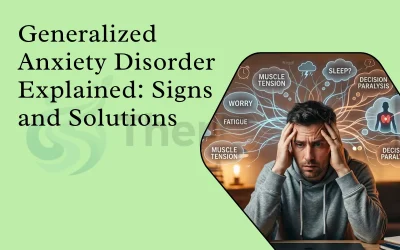
The DSM-5 defines Generalized Anxiety Disorder as excessive anxiety and worry occurring more days than not for at least six months [2] . This worry is difficult to control and is associated with physical symptoms like muscle tension, fatigue, and sleep disturbance.
Research from the National Institutes of Health (StatPearls, 2024) indicates that GAD often manifests as “vague somatic complaints [1].” Patients don’t always say they are worried; instead, they report chronic back pain or a sour stomach. In the United States alone, anxiety disorders affect approximately 19.1% of the adult population annually [3].
Key Diagnostic Signs:
- Constant worry about many different things [2].
- Persistent feeling of being “on edge [2].
- Extreme fatigue despite resting often [2].
- Muscle tension in neck or shoulders [2].
- Difficulty concentrating on simple daily tasks [2].
- Irritability with friends and family members [2].
- Sleep onset insomnia is very common [2].
The Neurobiology of the “Worry Loop”
The amygdala and the insula are the brain’s alarm centers. In a healthy brain, these areas fire during a threat and then quiet down. In a person with GAD, these regions remain hyperactive [4]. This is not a choice; it’s a neurological state where the brain is stuck in an “approach-avoidance” conflict.
“Worry is a chain of thoughts and images, negatively affect-laden and relatively uncontrollable.”
Thomas Borkovec, “Generalized Anxiety Disorder,” 1994
Modern research in Translational Psychiatry (2025) has identified the dorsolateral prefrontal cortex as a critical area for treatment. When this part of the brain is weak, it cannot “turn off” the hyperactive amygdala [4]. This creates a loop where the individual worries to avoid a bigger emotional shock—a concept known as the Contrast Avoidance model.
Practical Impact on Performance
In a professional context, GAD is a silent performance killer. It leads to “decision paralysis” where the individual over-analyzes every possible outcome to avoid a mistake. Mental health issues are estimated to result in $282 billion in annual costs due to lost productivity and medical expenses [3].
Operational Impacts:
- Slowed decision-making due to fear.
- Increased absenteeism; those with mental illness are unemployed at a rate of 9% compared to 4.3% for the general population [3].
- Strained team dynamics from irritability.
- Higher rates of error on tasks.
- Frequent requests for constant reassurance.
Comparative Analysis: Stress vs. Clinical GAD
| Feature | Everyday Stress | Generalized Anxiety Disorder |
| Trigger | Specific event (e.g., a deadline) | Often occurs without a clear trigger |
| Duration | Ends when the stressor is gone | Persistent for six months or more [2] |
| Physical Symptoms | Mild tension or temporary headache | Chronic pain, fatigue, and IBS [1] |
| Control | Manageable with basic time management | Feels uncontrollable despite logical efforts [2] |
| Daily Impact | Usually limited to one life area | Affects work, home, and social life [2] |
Evidence-Based Solutions and Treatment
The most effective approach to GAD is never just one thing. It requires a combination of pharmacological support, cognitive restructuring, and lifestyle adjustments.
Cognitive Behavioral Therapy (CBT)
CBT remains the gold standard. It works by identifying the “thinking errors” that fuel worry, such as catastrophizing. Meta-analyses show that while medications may provide faster initial relief, CBT demonstrates superior long-term outcomes and lower relapse rates [5].
“The aim of therapy is to make the patient’s internal dialogue more constructive and less self-defeating.”
Aaron T. Beck, “Cognitive Therapy and the Emotional Disorders,” 1975
Pharmacological Interventions
SSRIs (such as Sertraline or Escitalopram) and SNRIs (such as Venlafaxine) are the first-line medications recommended by major clinical guidelines [6]. They raise the baseline for what the nervous system can handle. This allows the patient to engage in therapy more effectively. Some doctors also use “Gold Carding” techniques in clinical workflows to expedite care for those with severe symptoms.
Treatment Frameworks:
- CBT focused on worry exposure.
- Medication to stabilize neural pathways (SSRIs/SNRIs) [6].
- Mindfulness to reduce amygdala firing.
- Regular aerobic exercise for stress regulation.
- Structured sleep hygiene protocols.
- Reducing caffeine and stimulant intake.
- Consistent progress monitoring with clinicians.
The Role of Precision Psychiatry
The future of GAD treatment is moving toward precision psychiatry. We are beginning to use fMRI data to predict which patients will respond better to Exposure Therapy versus Behavioral Activation [7]. This shift from a “trial and error” model aims to improve treatment effectiveness and reduce the time patients spend in distress [8].
If you are a manager or a clinician, you’ve got to realize that GAD is a heavy burden to carry. It’s not about “toughening up.” It’s about retraining a brain that has become too good at detecting threats that are not there.
Closing Thoughts on Recovery
The goal of treating Generalized Anxiety Disorder is not the total absence of anxiety. That’s impossible. The goal is to return the anxiety response to its proper place: a useful signal for real danger, not a background noise that drowns out the rest of life. Most patients see significant improvement within 12 to 16 weeks of consistent, evidence-based intervention.
“Recovery is not a linear process, but a series of adjustments toward stability.”
Edmund J. Bourne, “The Anxiety and Phobia Workbook,” 2020
I have seen people reclaim their lives from this disorder. It takes work, and it takes the right tools, but the data shows it is entirely possible. Don’t let your brain trick you into thinking this is just who you are. It’s a condition you have, and it’s one we know how to treat.
References
- [1]Munir, S., Takov, V., & Singh, G. (2024). Generalized Anxiety Disorder. StatPearls. https://www.ncbi.nlm.nih.gov/books/NBK441870/
- [2]American Psychiatric Association. (2013). Diagnostic and Statistical Manual of Mental Disorders (5th ed.). https://doi.org/10.1176/appi.books.9780890425596
- [3]University of Health Sciences and Pharmacy in St. Louis. (2026). Mental Health Statistics [2026]. USAHS. https://www.usa.edu/blog/mental-health-statistics/
- [4]Zhang, X., et al. (2025). Aberrant resting-state functional connectivity in medication-naïve generalized anxiety disorder: a whole-brain exploratory fMRI study. Frontiers in Psychiatry, 16. https://doi.org/10.3389/fpsyt.2025.1725066
- [5]Nasir, U., et al. (2025). Comparative efficacy of cognitive behavioral therapy and pharmacological treatment in generalized anxiety disorder. Insights-Journal of Life and Social Sciences, 3(4), 52–57.
- [6]National Institute for Health and Care Excellence. (2025). Guidelines for the treatment of generalised anxiety disorder and panic disorders in primary care. https://best.barnsleyccg.nhs.uk/media/dfehuntl/anxiety_management_guidelines.pdf
- [7]Stringer, H. (2025). The promise of precise, personalized mental health care. Monitor on Psychology, 56(6), 63. https://www.apa.org/monitor/2025/09/personalized-mental-health-care
- [8]Fernandes, B. S., et al. (2025). Moving toward precision and personalized treatment strategies in psychiatry. International Journal of Neuropsychopharmacology. https://doi.org/10.1093/ijnp/pyaf025